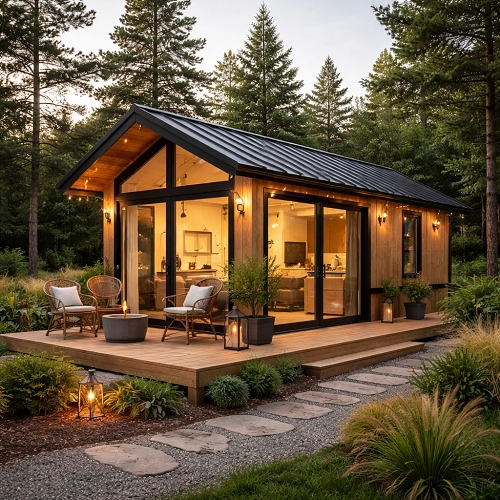
Pre-built tiny homes—also called factory-built or modular tiny homes—represent a convergence of architectural minimalism, advanced manufacturing, and sustainable design. Unlike traditional site-built houses, these dwellings are largely constructed in controlled factory environments and then transported to their final location. This approach allows for precision engineering, predictable costs, and accelerated timelines, while also raising complex technical questions around structure, utilities, codes, and long-term performance.
At the heart of any pre-built tiny home is its structural system. These homes typically fall into two categories:
Load considerations are more demanding than they appear. Engineers must account for:
Light-frame wood construction dominates the industry, but higher-end models may use steel framing or hybrid systems to reduce weight while increasing rigidity. Shear walls, metal strapping, and engineered fasteners are critical, especially for homes designed to travel long distances.
Factory construction changes the technical workflow of homebuilding:
Advantages
Challenges
Pre-built tiny homes often use panelized assemblies (walls, floors, roofs built separately) or fully volumetric modules, each with different implications for wiring paths, insulation continuity, and thermal bridging.
One of the most technically complex aspects of pre-built tiny homes is regulatory compliance. Depending on design and location, a tiny home may fall under:
Key technical challenges include:
Manufacturers must often design homes to meet multiple overlapping standards, increasing engineering complexity but improving safety and resale value.
Because tiny homes have a high surface-area-to-volume ratio, thermal performance is critical.
Common insulation strategies include:
Air sealing is as important as insulation thickness. Factory assembly allows for blower-door-verified envelopes that outperform many conventional homes, but improper detailing at roof-wall or trailer interfaces can compromise performance.
Tiny homes typically operate on:
Panel placement, wire routing, and heat dissipation require careful coordination due to tight wall cavities.
Water systems may be:
Freeze protection is a major concern, especially for mobile units. Designers often use interior plumbing chases and heat-taped supply lines to prevent cold-weather failures.
Efficient climate control is achieved through:
Oversizing HVAC equipment can cause humidity and comfort issues, so precise load calculations are essential.
Tiny homes concentrate daily wear into a small footprint, making material selection crucial. High-traffic finishes, moisture-resistant flooring, and fire-rated assemblies are common in quality builds.
Fire safety considerations include:
Some manufacturers now offer fire-resistant exterior cladding and Class A roofing systems, especially in wildfire-prone regions.
For pre-built units, transportation is a structural event. Engineers must design for:
Once delivered, site integration involves:
Poor site preparation can undermine even the best factory construction.
Pre-built tiny homes often emphasize sustainability, but true performance depends on technical execution:
Lifecycle analysis increasingly influences design decisions, pushing manufacturers toward durable assemblies over disposable minimalism.
Pre-built tiny homes are far more than simplified houses—they are compact, highly engineered systems where every inch and every decision matters. From structural loads and thermal envelopes to code compliance and off-grid infrastructure, these homes demand rigorous technical planning to succeed.
As manufacturing technology improves and regulations evolve, pre-built tiny homes are poised to become not just a niche lifestyle choice, but a serious, technically sophisticated response to housing affordability, sustainability, and mobility in the modern world.